Concrete Canvases: Where Kinshasa’s Soul Meets Steel and Sunlight
Walking through Kinshasa, I didn’t just see buildings—I felt them. Their cracked facades, bold colors, and improvised designs aren’t just structures; they’re stories. You’d never expect a city often labeled “chaotic” to be such a raw expression of artistry. Every corner reveals how people reshape space with creativity born from necessity. This is architecture not from textbooks, but from life—alive, loud, and impossible to ignore. In a place where resources are limited and change is constant, the city grows like a living organism, shaped by the hands of its residents. Kinshasa’s built environment whispers resilience, shouts identity, and sings in hues of rust, cobalt, and sun-bleached yellow. Here, steel and sunlight are not just materials—they are mediums of meaning.
First Impressions: Chaos or Creativity?
Kinshasa’s skyline does not rise in symmetry or adhere to master plans. Instead, it pulses outward in layered clusters of rooftops, antennas, and colorful canopies that seem to grow like vines. To the untrained eye, the city may appear disordered, a tangle of haphazard construction and unchecked expansion. Yet, a closer look reveals an intricate language of form and function emerging from necessity. There is rhythm in the repetition of corrugated iron, poetry in the way balconies stretch toward the light, and symmetry found not in blueprints but in the collective instincts of its people. What some label urban decay, others recognize as urban improvisation—a city building itself one brick, one beam, at a time.
The sounds of construction are a constant soundtrack: the rhythmic clanging of hammers shaping metal sheets, the low hum of generators powering small workshops, and the occasional shout of a mason directing his team. These are not isolated projects but continuous acts of renewal. Buildings evolve as families grow, incomes shift, and materials become available. A ground floor might start as a storage space, transform into a shop, then expand into a guest room with an added staircase. These incremental changes reflect not disorder, but adaptability—a kind of architectural breathing that allows the city to expand and contract with the lives within it.
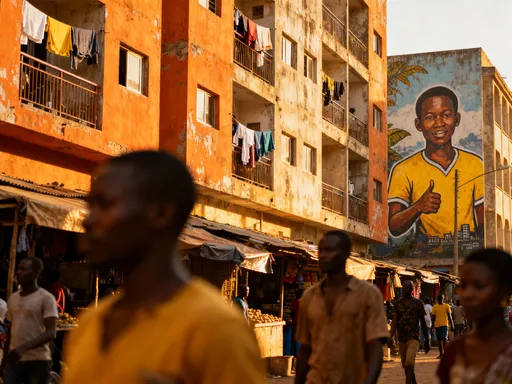
Sensory experiences deepen the impression of Kinshasa’s architectural vitality. Laundry flutters between buildings like flags of domestic life, strung across alleys no wider than a car. Murals painted on peeling walls depict saints, musicians, or political figures, their colors fading under the equatorial sun but still carrying weight. Even graffiti functions differently here—not as vandalism, but as commentary, prayer, or advertisement. The city’s surfaces are never truly blank; they are always in dialogue with the people who use them. Every chipped surface, repurposed door, or mismatched window tells a story of survival, aspiration, and self-expression.
The People’s Architecture: Homes That Tell Stories
In neighborhoods like Kalamu and Matonge, homes are not merely shelters—they are declarations. Built largely by families themselves or with the help of local masons, these houses emerge from a blend of available materials and personal vision. Cement blocks form the base, but their appearance is often transformed with hand-painted borders, geometric patterns, or embedded bottle caps and tiles. Roofs of corrugated iron reflect the heat, but beneath them lie carefully arranged spaces meant to protect, nurture, and celebrate family life. These are not cookie-cutter dwellings; they are unique compositions shaped by memory, culture, and limited means.
Color plays a central role in this domestic architecture. A bright blue door may signify protection, while a yellow facade could express joy or optimism. Some homes incorporate symbolic shapes—circles for unity, stars for guidance—painted above doorways or etched into stucco. In many cases, families embed small religious icons or recycle old signs into their walls, turning everyday objects into elements of design and meaning. These choices are not whimsical; they reflect deep cultural codes passed down through generations, even as they adapt to urban realities.
Spatial organization within homes also follows informal logic rooted in social values. Courtyards function as communal spaces where neighbors gather, children play, and meals are prepared outdoors. Even in denser areas, residents create semi-private zones using fabric screens, potted plants, or low walls. These subtle demarcations allow for privacy without isolation, reinforcing the importance of community in daily life. The layout of a home often evolves with the family—rooms are added for newlyweds, extended to accommodate elderly parents, or converted into small businesses when needed.
From the outside, these homes may seem modest or even fragile, but their significance goes far beyond aesthetics. They represent a form of agency—people shaping their environment despite limited resources and minimal state support. In Kinshasa, building a home is not just a practical task; it is an act of resistance, dignity, and hope. Each structure stands as proof that even in the absence of formal planning, human creativity and determination can build something lasting, expressive, and deeply personal.
Religious Spaces: Temples of Light and Music
Faith is visible in Kinshasa’s skyline. Churches and mosques rise like beacons across the city, their forms ranging from humble neighborhood chapels to expansive religious complexes capable of holding thousands. Especially striking are the large Pentecostal churches, whose architectural ambition mirrors their spiritual fervor. Towering spires, domes painted in celestial blues and golds, and expansive open-air auditoriums are common features. These are not just places of worship; they are centers of community, performance, and visual spectacle. The music that pours from them on Sundays reverberates through entire districts, but so too does their architecture command attention.
Inside these compounds, design serves both function and symbolism. Stained glass windows, often locally crafted, filter sunlight into rainbow patterns across concrete floors. Murals depict biblical scenes rendered in vibrant tropical colors—David wearing an Afro, angels dancing in Congolese textiles. Pulpits are elevated like thrones, and stages are equipped with professional sound systems and LED screens, reflecting the importance of multimedia in modern worship. These spaces are built to accommodate not only prayer but also theater, music, and social gatherings, reinforcing religion as a holistic force in daily life.
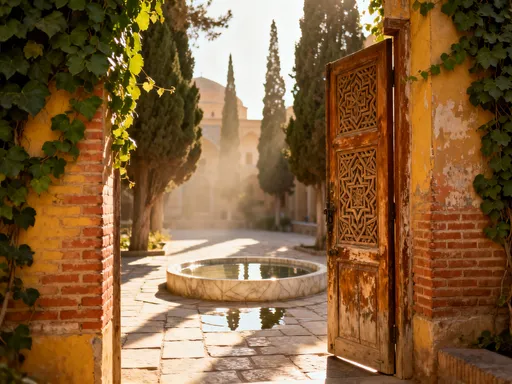
Mosques, while generally more subdued in scale, also exhibit careful attention to detail. Minarets may be modest, but their walls are often adorned with Arabic calligraphy, painted or carved with precision. Courtyards are kept clean and shaded, providing spaces for communal prayer and quiet reflection. Many Islamic centers include schools and community kitchens, emphasizing service as a core value. The architecture reflects restraint and devotion, with geometric patterns and arched entrances drawing from broader Islamic traditions while adapting to local conditions.
What unites these diverse religious structures is their role as cultural anchors. They are maintained not through government funding but through the contributions of congregants, making them truly communal projects. Their construction often involves collective labor, with members donating time, materials, and money. In this way, the act of building becomes a spiritual practice—one that strengthens bonds and expresses shared belief. These spaces are not isolated from the city; they are integrated into its rhythm, shaping neighborhoods and offering refuge, guidance, and beauty in equal measure.
Markets as Living Structures: Commerce in Motion
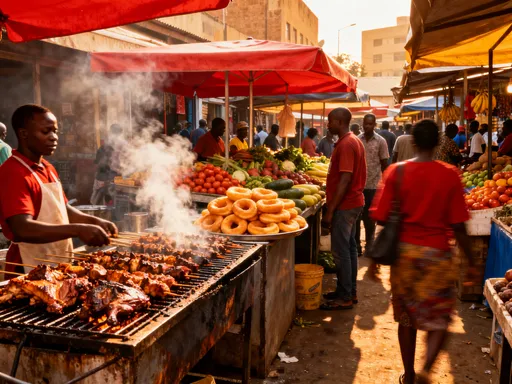
If Kinshasa has a heartbeat, it beats in its markets. Places like Marché Central and SIM are not static shopping areas but dynamic ecosystems of trade, movement, and architectural evolution. What might begin as a simple stall can, over time, develop into a multi-level structure with walls, shelves, and signage built from scrap metal, wood, and reused plastic. These markets are laboratories of adaptive design—each vendor modifying their space to maximize visibility, security, and functionality. The result is a patchwork of micro-architecture that defies standard categorization.
Verticality defines these commercial zones. Vendors stack goods from floor to ceiling, and overhead, wooden beams support second-level storage or even small offices. Canopies stretch across aisles to shield shoppers from rain and sun, creating a network of semi-enclosed paths that feel like indoor streets. Signage—painted in bold letters, often in Lingala, French, or English—functions as both advertisement and decoration. Bright reds, electric yellows, and deep greens turn the market into a sprawling canvas of commercial art, where every surface communicates value, identity, or humor.
These spaces are constantly shifting. A vendor’s success might lead them to expand their stall, annex a neighboring space, or invest in better materials. After a fire or demolition, stalls are quickly rebuilt, often with improved design. This fluidity means that no two visits to the same market feel identical. The layout adapts organically, responding to foot traffic, competition, and seasonal demand. Despite the lack of formal planning, there is an internal logic—a kind of urban intelligence that emerges from daily use and negotiation among traders.
Beyond economics, markets serve as social hubs. They are places where news spreads, friendships form, and cultural trends emerge. Grandmothers bargain for cassava, teenagers browse pirated DVDs, and mechanics sell spare parts from repurposed shipping crates. The market is open from dawn to dusk, and its energy never fully fades. In many ways, it is the true civic center of Kinshasa—more accessible and more representative than any government institution. Its architecture, born of repetition, repair, and reinvention, mirrors the resilience of the people who sustain it.
Public and Political Buildings: Power in Concrete
Amid the organic growth of Kinshasa’s neighborhoods, certain structures stand out for their rigid formality: government buildings, administrative offices, and former colonial edifices. The Palais du Peuple, home to the national parliament, is perhaps the most iconic—a massive concrete complex with clean lines and symmetrical layout, surrounded by high walls and security checkpoints. Unlike the improvisational architecture of daily life, this building speaks a language of order, authority, and distance. Its design prioritizes monumentality over accessibility, projecting power through scale and isolation rather than engagement.
Colonial-era buildings, many dating back to the Belgian administration, share this sense of detachment. Constructed with imported materials and European styles, they were designed to separate the ruling class from the local population. Wide verandas, tall ceilings, and barred windows reflect a desire for comfort and control, not integration. Today, many of these buildings remain in use—repurposed as ministries, embassies, or cultural institutions—but their architecture still feels foreign, out of sync with the vibrant energy of the streets around them.
The contrast between these formal structures and the rest of the city is stark. While homes, markets, and churches evolve through community use, public buildings often remain static, their interiors inaccessible to ordinary citizens. Renovations happen slowly, if at all, and their surrounding plazas are frequently empty, patrolled by guards rather than filled with people. There is little evidence of participatory design—no murals, no personal touches, no signs of life beyond official function. They exist as reminders of centralized power, but not as spaces of belonging.
Yet, even these structures are not entirely immune to the city’s influence. Graffiti occasionally appears on their outer walls, and market vendors sometimes set up near their gates, reclaiming public space in small acts of quiet resistance. Over time, nature too reclaims parts of these buildings—creepers climb down balconies, and rain erodes facades. In subtle ways, Kinshasa refuses to let any structure remain untouched. Even symbols of authority must negotiate with the realities of the city’s climate, culture, and collective will.
Street Art and the Urban Palette: Color as Resistance
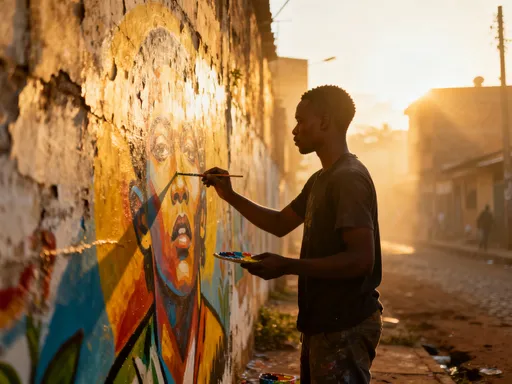
Color in Kinshasa is never neutral. It is a statement, a declaration, a way of claiming space in a city where land and visibility are precious. Walls that might elsewhere be blank or ignored become canvases for expression. Murals cover entire façades—depicting musicians, politicians, family scenes, or abstract patterns. Graffiti appears on retaining walls, overpasses, and the sides of buses, often in vibrant combinations that seem to vibrate under the sun. These works are not commissioned by governments or galleries; they emerge from youth collectives, independent artists, and anonymous creators who see the city as their museum.
This visual culture is deeply tied to social consciousness. Many murals carry messages about unity, environmental care, or national pride. Others critique corruption, inequality, or historical amnesia. Because traditional media can be restricted, public art becomes a vital channel for dialogue. An image of a raised fist painted next to a slogan about justice speaks louder than any headline. A portrait of a local hero, surrounded by symbols of resilience, reminds passersby of their shared heritage. Art here is not decorative—it is functional, a way of shaping public thought and preserving memory.
The materials used are often humble—spray paint, leftover house paint, charcoal—but the impact is profound. Some artworks are temporary, meant to exist only until the next rain or the next coat of whitewash. Others are carefully maintained by communities who adopt them as landmarks. In certain neighborhoods, entire alleyways have become open-air galleries, where every wall tells a different story. Artists collaborate across disciplines, combining painting with mosaics made from broken tiles or bottle glass, turning waste into beauty.
What makes this movement powerful is its accessibility. Unlike art confined to museums, street art belongs to everyone. Children point to figures they recognize, elders discuss the meanings behind symbols, and tourists pause to take photographs. It democratizes creativity, allowing voices that are often marginalized to occupy visible space. In a city where formal power is concentrated, this form of expression redistributes visibility and value. Every painted wall says: we are here, we see you, and we are not silent.
The City That Builds Itself: Kinshasa’s Future in Flux
Kinshasa is not a city that waits for permission to grow. It builds itself—every day, in countless small decisions made by individuals asserting their right to shelter, work, and expression. This self-made urbanism is both its greatest strength and its most pressing challenge. Without coordinated planning, infrastructure struggles to keep pace: roads erode, drainage systems overflow, and electricity remains inconsistent. Rapid population growth strains resources, and environmental concerns—deforestation, waste management, flooding—demand urgent attention. The very adaptability that fuels innovation also complicates long-term sustainability.
Yet, dismissing Kinshasa’s architecture as informal or illegitimate misses the point. This is not a failure of planning but a different kind of order—one based on resilience, improvisation, and community intelligence. Architects and urban planners around the world are beginning to study the city not as a problem to be fixed, but as a model of adaptive design. How can limited materials yield maximum meaning? How can structures evolve with their users? Kinshasa offers answers born not from theory, but from decades of lived experience.
The future of the city need not mean erasing its character. Instead, it could mean integrating its strengths into broader systems—supporting self-built neighborhoods with better access to water, sanitation, and legal land rights. It could mean investing in public spaces that reflect local aesthetics rather than imported models. It could mean recognizing street artists, masons, and vendors not as informal actors but as co-creators of the urban landscape. True development should not impose uniformity but amplify what already works.
In the end, Kinshasa’s beauty is not found in permanence but in transformation. Its walls are not meant to last forever; they are meant to bear witness. They carry the marks of rain, fire, celebration, and repair. They reflect a society that constantly reimagines itself, brick by brick. This is not a city of monuments frozen in time, but a living canvas where steel, sunlight, and human spirit come together in unpredictable harmony. To walk through Kinshasa is to understand that architecture is not just about buildings—it is about people, and the endless ways they find to say: I am here, and I belong.